 DE
 EN
Rad am Ring
From a child at the trackside to a rider on the Nordschleife.
- Format
- 24 hours
- Course
- Nordschleife
- Team
- Four riders
Some places stay with you throughout your life, even though you never planned for them to. The Nürburgring is one of those places for me.
That is why my Rad am Ring story does not begin on a Friday lunchtime on the motorway from Stuttgart to the Eifel, but roughly 40 years earlier.
A child from Cologne at the Nürburgring
I was eight or nine years old and desperately wanted to go to the Nürburgring. Why exactly? No idea. But I wanted to be there.
My father, who sadly is no longer with us, made that wish come true. He took me to the Nürburgring, where I drove a hire kart and discovered the place for the first time.
Back then, I could not have known how often I would return later in life.
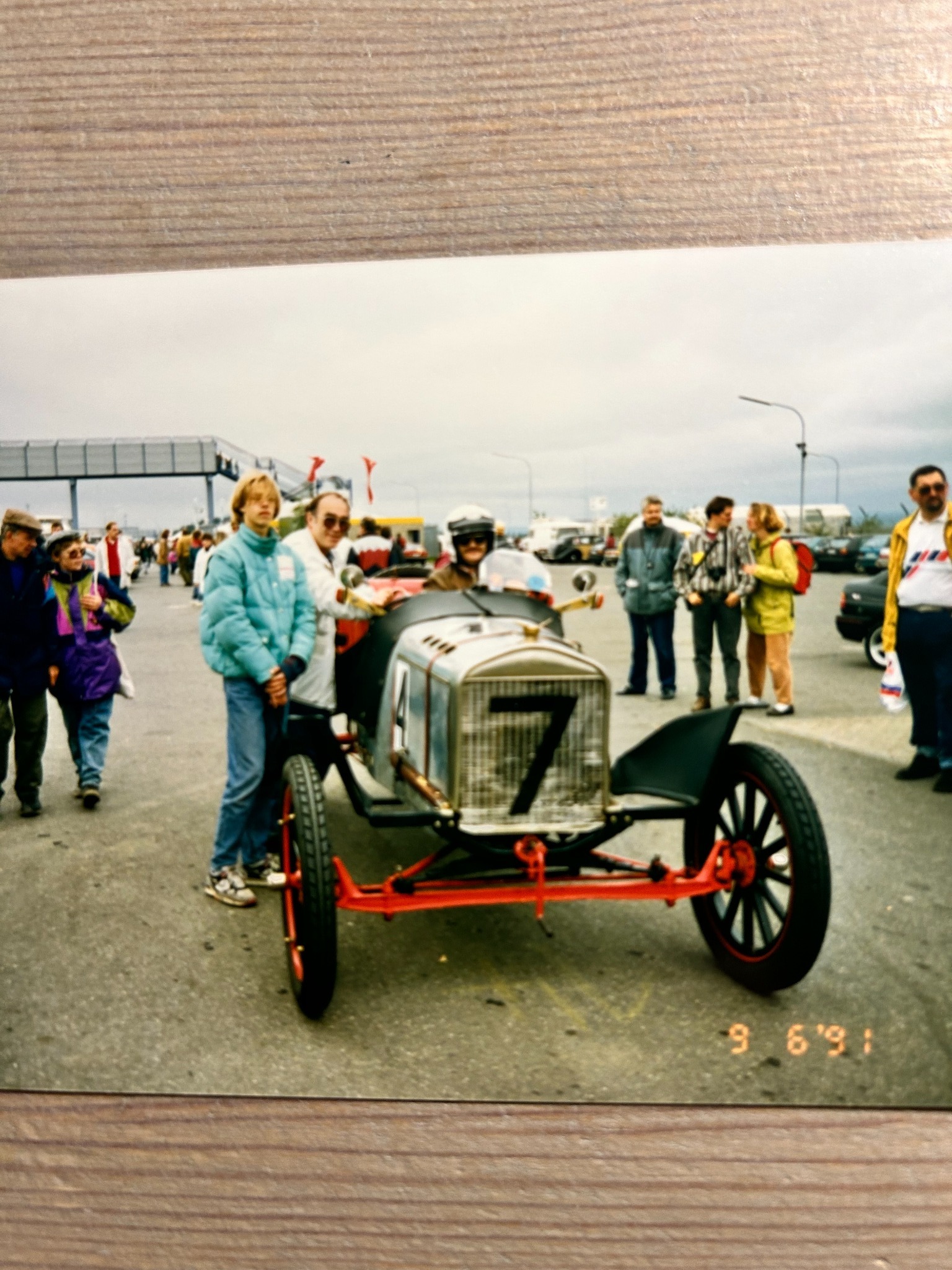
At 15, I attended the Oldtimer Grand Prix and rode a lap of the Grand Prix circuit as a passenger.
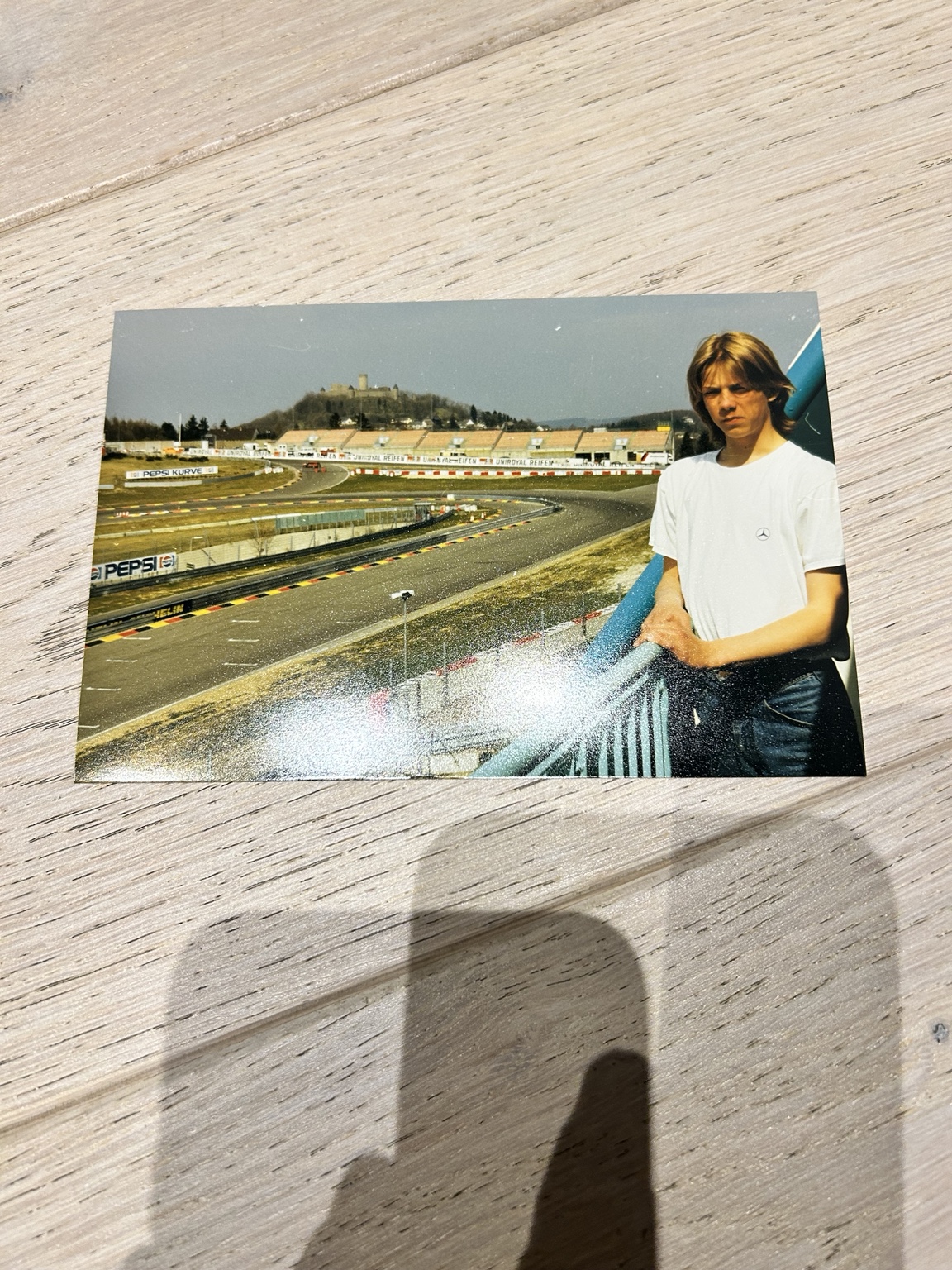
Then came another view of the Nürburgring: on foot. While preparing for the Cologne Marathon, I entered the former Nürburgring run and completed a full lap of the Nordschleife.
There was also a visit with my mother’s partner, who had invited us to the Dorint. My brother and I seemed to spend the entire day glued to the balcony, watching the race cars.
Looking at those photographs now, what makes me smile most is how long this place has already been part of my life.
From spectator to part of the sport
Over time, my perspective on this place changed. Watching became participating.
At the end of my studies, I had the opportunity to work as an intern at BMW Motorsport – and travel to the Nürburgring with the team.
In 2005, I experienced the 24-hour race on the Nordschleife for the first time. No longer as a spectator, but in an organisational role for BMW Motorsport.
I was no longer standing behind the fence, watching events unfold. I was able to make a small contribution behind the scenes, helping the race team focus on the thing that mattered: the race.
Anyone familiar with the Nürburgring 24 Hours knows that “organisational role” sounds far more orderly than a weekend like that actually feels.
Nordschleife. Paddock. Teams. Drivers. Fans. Timetables. Changes. Radios. Very little sleep. And always something that refuses to go to plan.
Looking back, it was surprisingly good preparation for a 24-hour bicycle race. 😉
Over the years, the Nürburgring never lost its special pull. I returned again and again – for the 24-hour race, for the Nordschleife, in different roles and functions.
I have experienced this place full and empty. Deafeningly loud and completely silent. In sunshine, rain and Eifel cold. During the day and in the middle of the night.
I knew the circuit. I knew the paddock. I knew that particular feeling when darkness falls over the Nürburgring and nobody even considers calling it a day.
What I did not know was how it felt to be out on the circuit myself.
Then a rather unusual opportunity appeared:
Nordschleife.
Road bike.
24 hours.
Rad am Ring.
And with it, the chance to experience this place from an entirely new perspective.
And suddenly, an opportunity appears
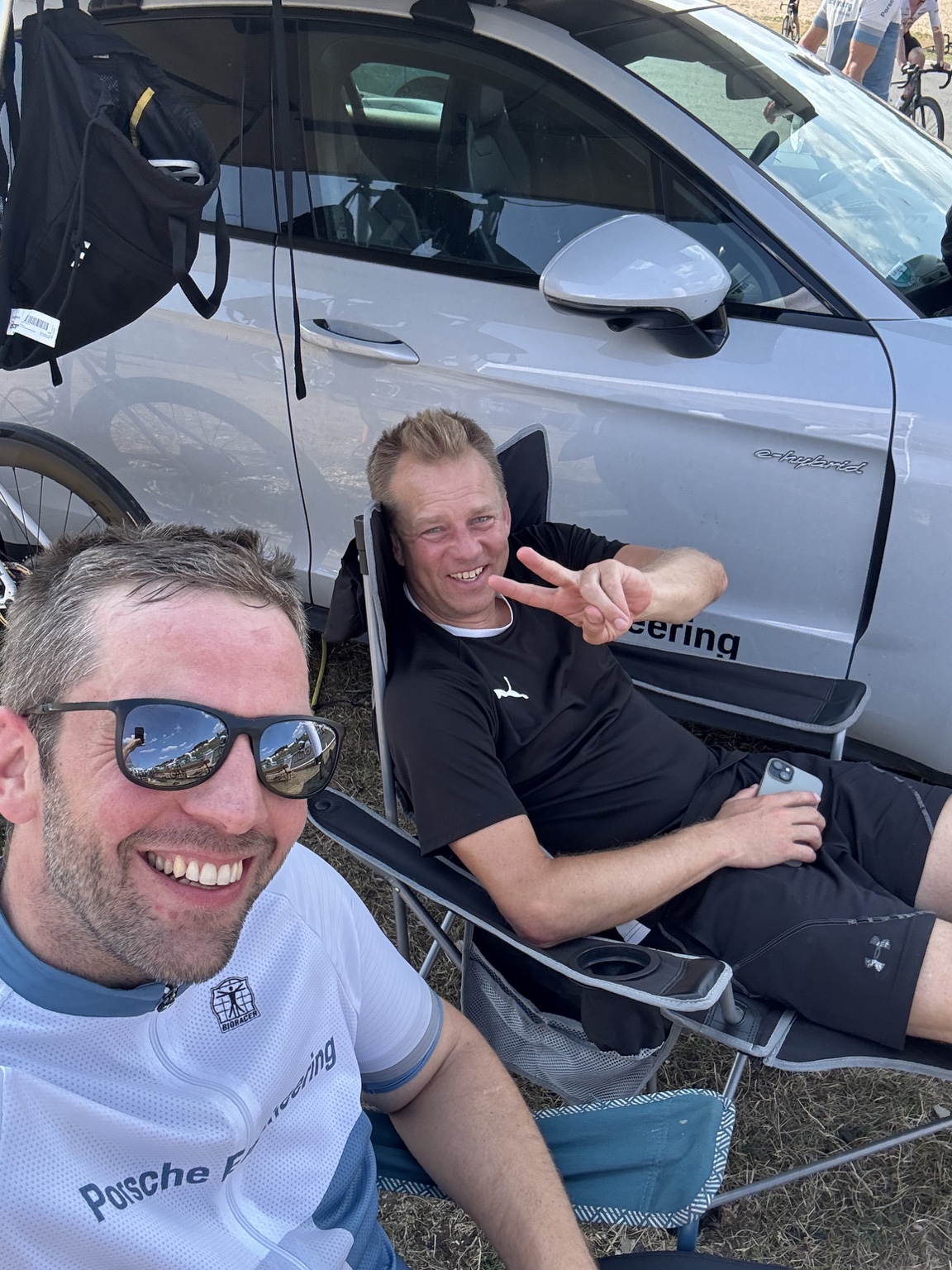
The way I ended up on the start line suits this adventure rather well. A chance connection led me to the Porsche Engineering group. Then a place became available in a four-rider team. For me, the decision was made.
Our first conversation was gloriously unspectacular: a Microsoft Teams call. Malte explained how this strange 24-hour bicycle race worked. Frank and I were new to it; Sandra and Malte had done it before.
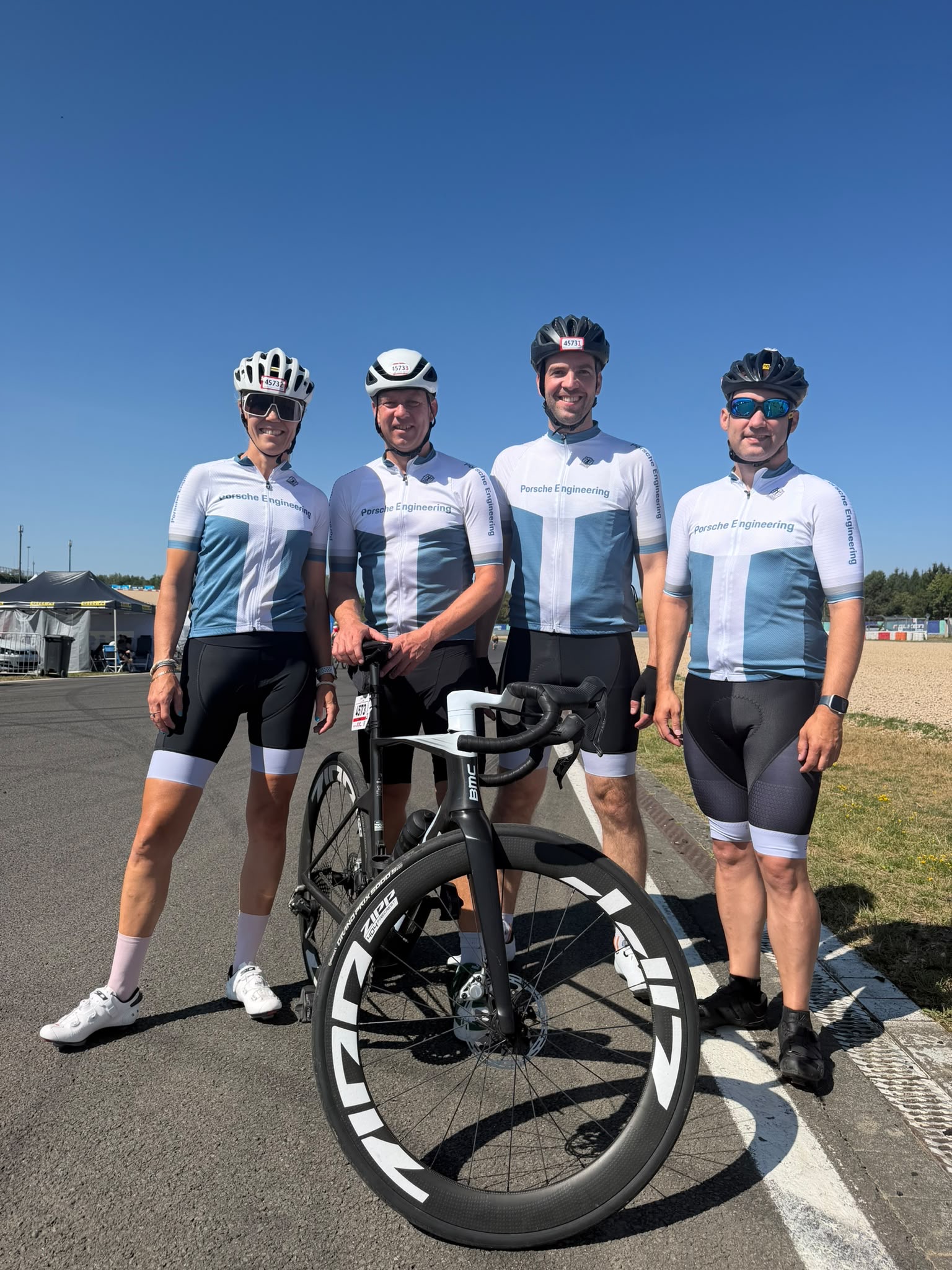
Two weeks before the race, I quickly bought a small tent. Malte and I arranged to travel together from Stuttgart.
As a group of four, we began seriously debating our riding order and how we would organise the changes.
Pretty funny in hindsight. We had a plan. Or at least we thought we did.
Friday: how much pasta do you need for 24 hours?
Malte picks me up in Stuttgart at lunchtime. Car full. Bikes packed. Tent packed. Off towards the Eifel.
Our first shared stop is not the circuit, but a supermarket in Adenau. There, we face one of endurance cycling’s great questions: how much food do four people need for 24 hours?
Pasta? A lot.
Water? A lot.
Sweets? Obviously a lot.
Bananas? Of course.
And because none of us really knows how much “a lot” is, we do what people do in situations like this: we simply buy everything.
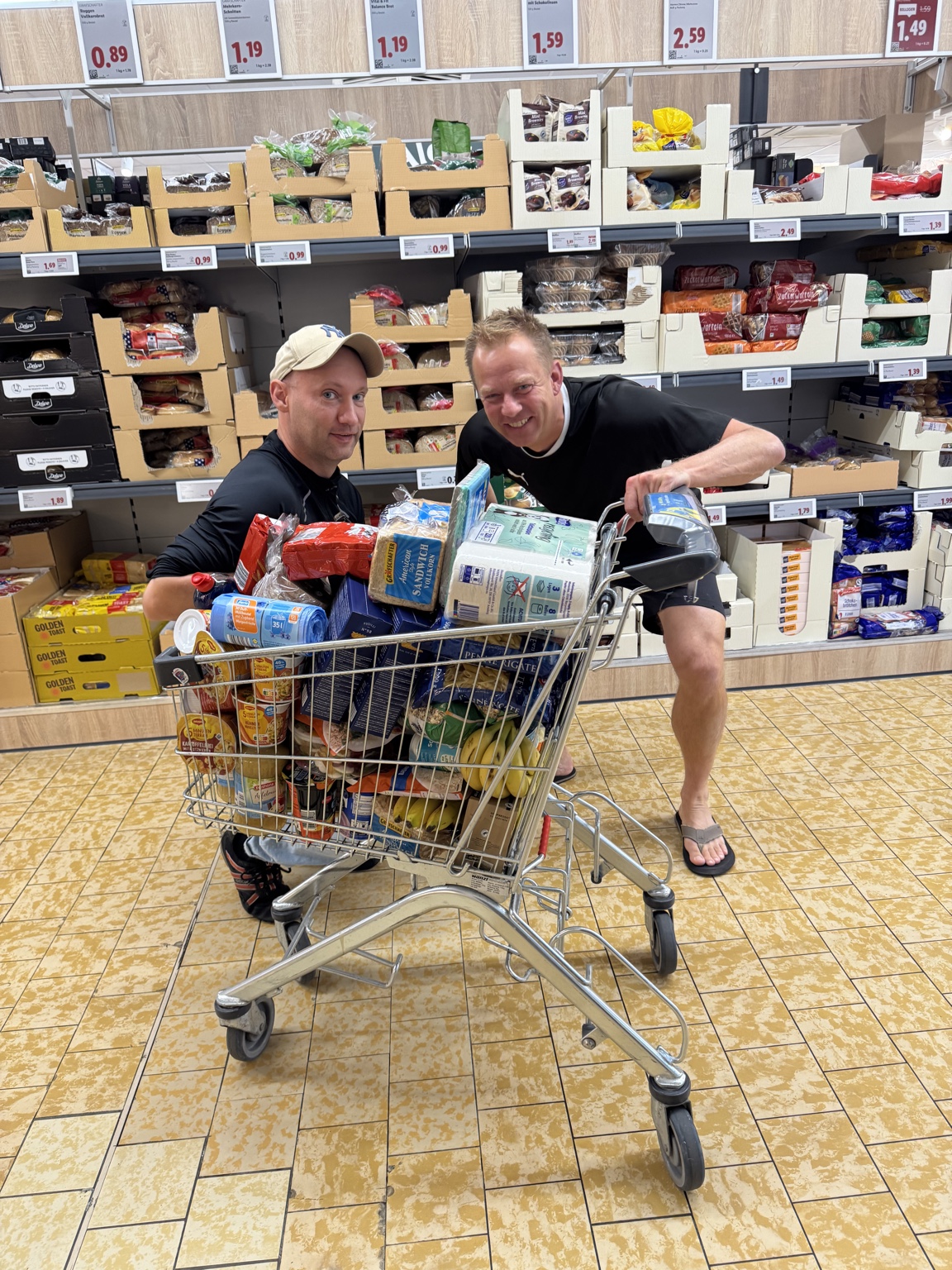
The trolley ends up overflowing. A small spoiler: we had far too much.
The paddock becomes a campsite
When we arrive, other members of Porsche Engineering have already built much of the camp. And “camp” describes it better than “paddock”.
Beer tables.
Communal tents.
Fridges.
A barbecue.
Bikes.
Cars.
Sleeping tents.
People everywhere.
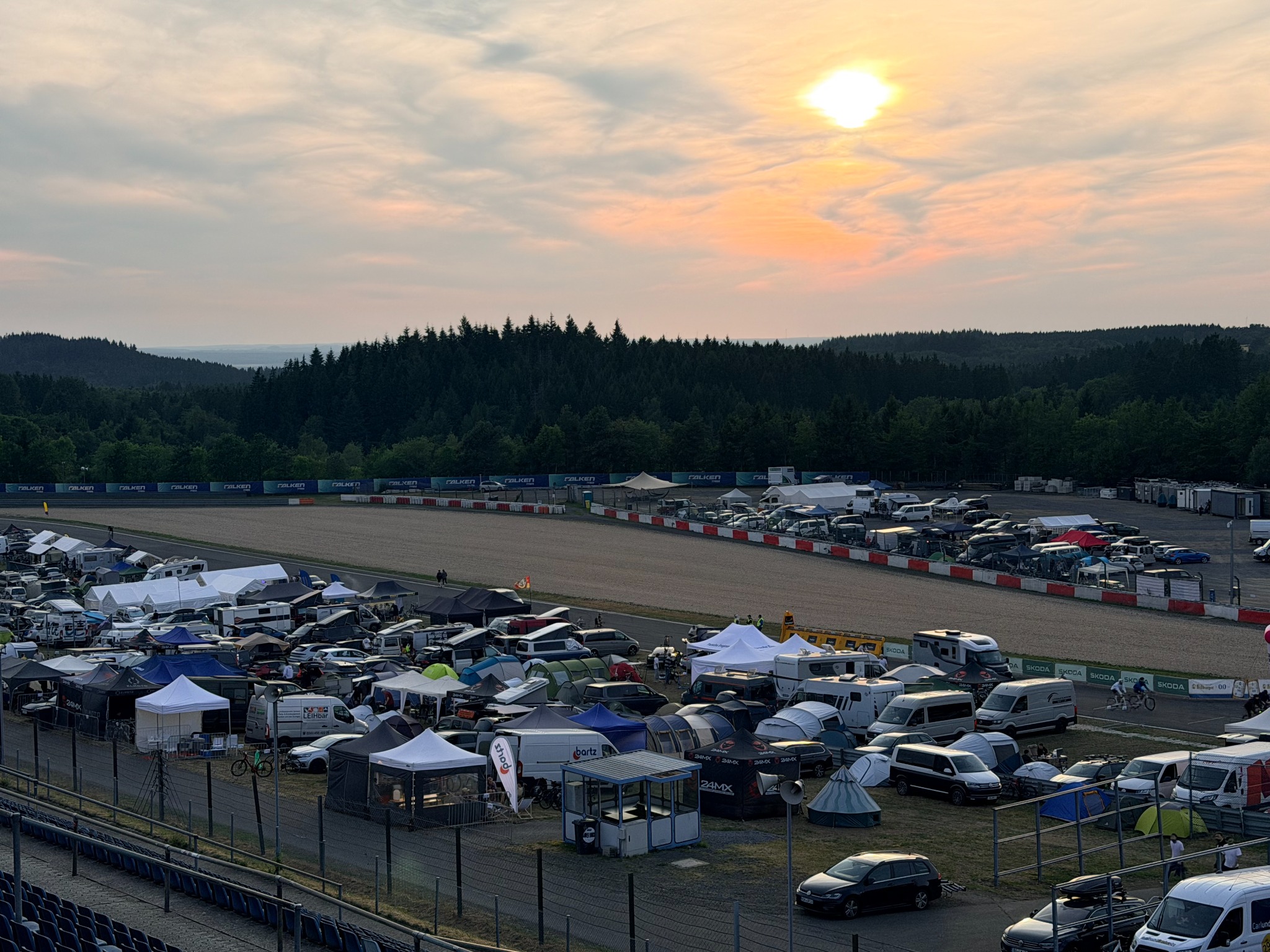
Where motorsport fans camp during the 24-hour race, cyclists take over the Nürburgring this weekend. Small teams beside large groups. Motorhomes beside tiny tents.
Some setups look as though a professional cycling team is preparing for the Tour de France. And right in the middle stands the little tent I bought two weeks earlier. It will do.
That evening we barbecue together. The teams get to know one another. Bikes are prepared, equipment sorted. Slowly, it becomes clear: this is going to be more than a bicycle race.
Saturday: now it gets serious.
The first night is short.
Showering here, incidentally, is rather different from a wellness weekend. You take your things to the public showers. Athletes everywhere, each trying to feel vaguely fresh. That too is part of the atmosphere.
On Saturday morning, the entire paddock wakes up. Breakfast. Bikes. Race numbers. One more adjustment. Eat again. One more trip to the toilet.
Time disappears. Support races are already running on the circuit. You watch, talk and slowly become nervous.
Then the start of the 24-hour race approaches.
We had made a strategically brilliant decision: Frank would start.
Frank used to be a licensed racer. The rest of us were mainly wary of setting off in one enormous field. You could also say we were scared.
Then it is my turn
Frank is riding. From this point on, you watch the tracking. You see where your rider is and start calculating.
When do I need to leave?
When do I put my shoes on?
When does the helmet go on?
We had agreed a fixed procedure for each rider change. Perhaps not the fastest possible method, but a safe one.
Safety mattered more to us than the three seconds a perfect Le Mans-style change might have saved.
The transponder sits in a special bottle and is passed to the next rider like a relay baton.
Then Frank arrives.
Hand-over.
Transponder.
Mount the bike.
Go.
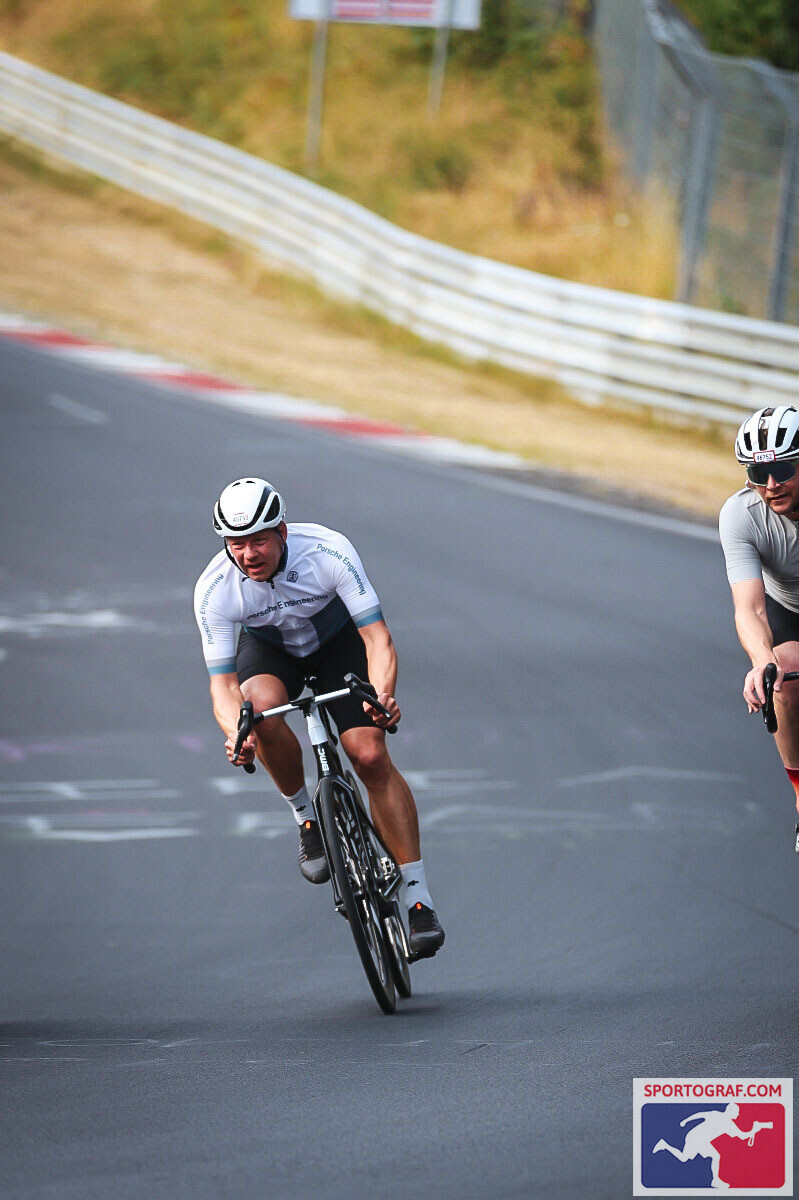
My first lap of the Nordschleife
I do not know whether a first lap can ever be described properly.
I knew all these names.
Fuchsröhre.
Breidscheid.
Hohe Acht.
Pflanzgarten.
Döttinger Höhe.
For years, they had been sections of a motor-racing circuit to me. Now I am riding them myself. On a bicycle.
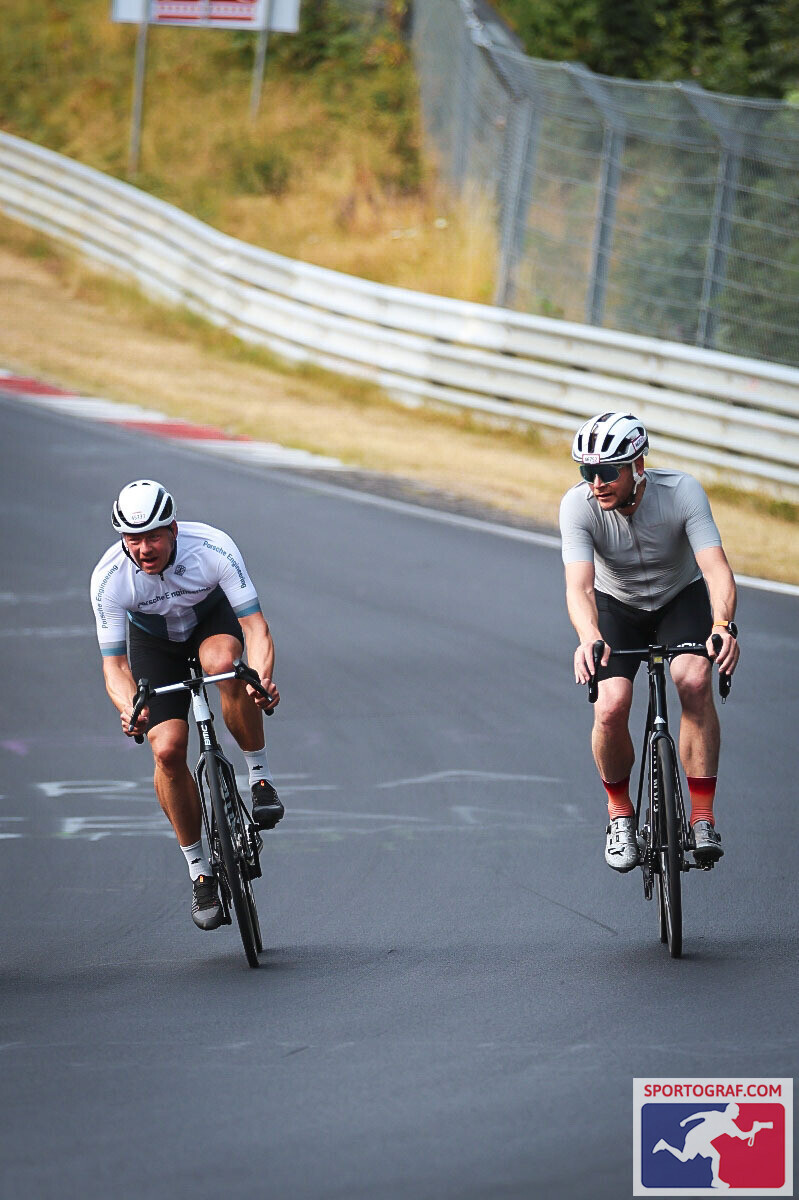
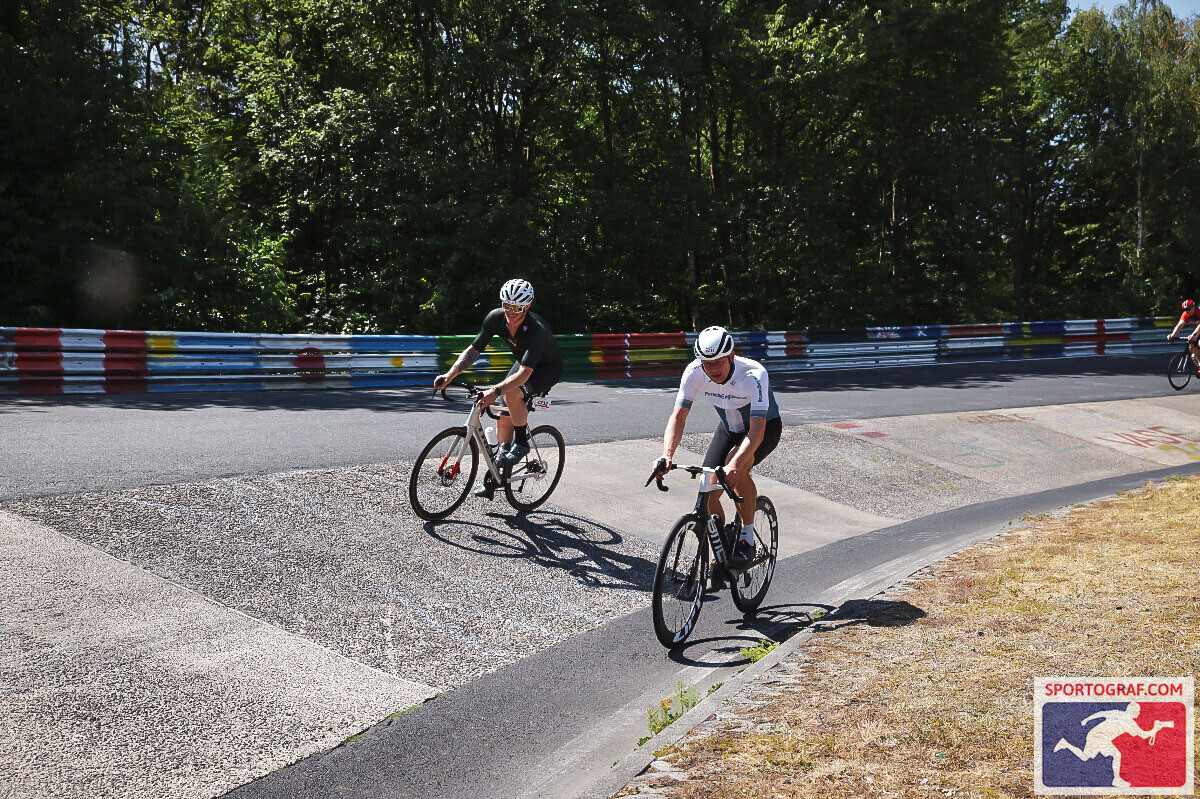
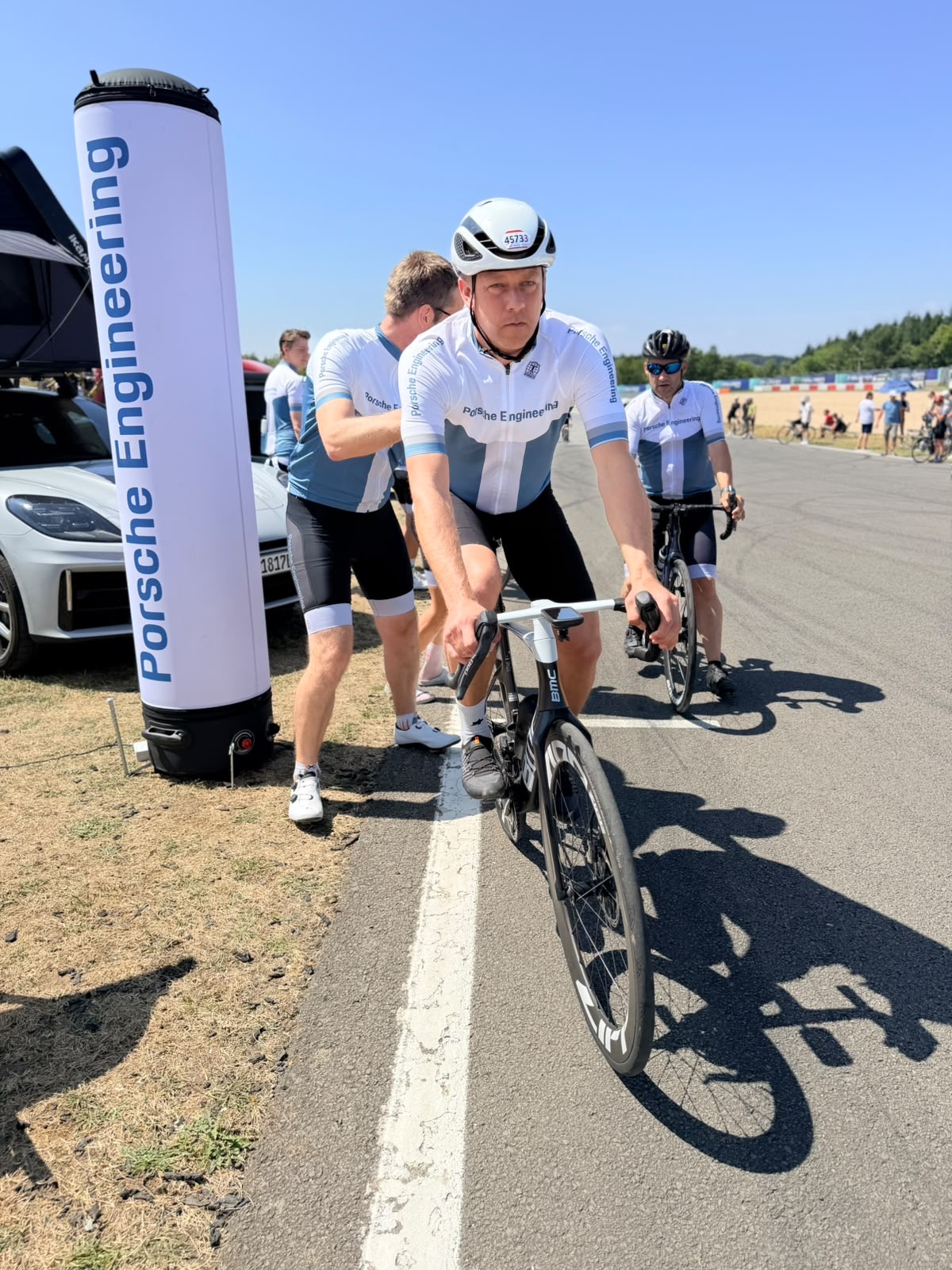
The first thing that strikes me is the width of the track. And that tarmac.
Then comes Fuchsröhre. The speed rises.
67.
68.
A little over 70.
That is quite enough for me. Others descend much faster. Respect. Not me. My family would like to see me again and, personally, I have a certain interest in that too.
Then down to Breidscheid. Afterwards comes the section where the Nordschleife makes it very clear that it is not made only of spectacular descents: the climb to Hohe Acht.
At the top waits one of Rad am Ring’s secret stars: the DJ. Twenty-four hours. Music. Fog. Lights. Cyclists fighting their way up the hill.
The first time, it is funny. At night, this place will mean something entirely different.
From there, the road drops again. As you gradually understand how the circuit works, an incredible flow develops – almost like a wild-mouse roller coaster towards Pflanzgarten.
Then Döttinger Höhe. Now you need luck. Find a good group and a proper train forms back towards the paddock. Slipstream. Speed. One last effort.
Then comes the changeover zone. Sandra is waiting. Pass the transponder. Done.
My first Nordschleife lap on a road bike.
What a feeling.
A three-hour break? Not a chance.
Now our rhythm begins. Frank. Me. Sandra. Malte. Then back to the beginning.
Beforehand, I had thought: four riders, one on track, so I will have roughly three hours off. What am I going to do with all that time?
The answer: nothing. Because those three hours do not exist in reality.
You get off the bike. First, you tell everyone what happened. You change, freshen up, perhaps stretch a little. Then you have to eat. Maybe cook. You look after the next rider. Try to sit down for a moment.
Then you look at the tracking.
Wait. He is already there?
And you have to leave again.
Four riders become a team
I had underestimated what happens next.
We may be riding as a four-person team, but Porsche Engineering has around nine or ten teams on site. Because everyone follows their own rhythm, someone is always riding, returning or preparing to go out.
People help. Cook. Check in. Track riders. Talk about lap times. Someone needs something; somebody else has it.
Separate teams become one large team.
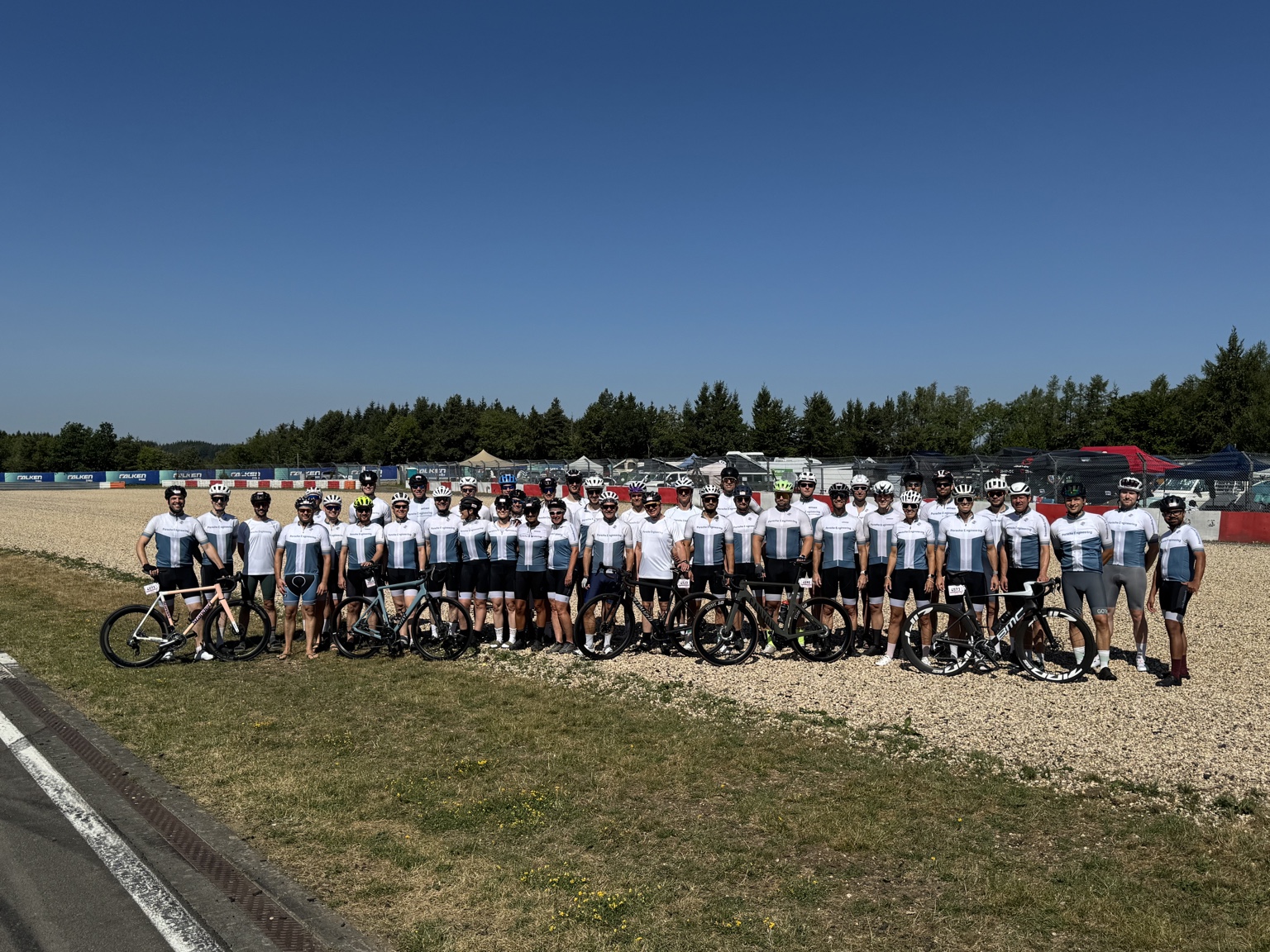
For me, that is one of the things that makes Rad am Ring so special.
Performance matters, and of course people look at times. But in the middle of the night, it matters very little who was two minutes faster.
What matters then is that somebody is there.
And then darkness falls
My final daylight stint runs into the evening. The sun disappears over the Eifel and the Nürburgring changes.
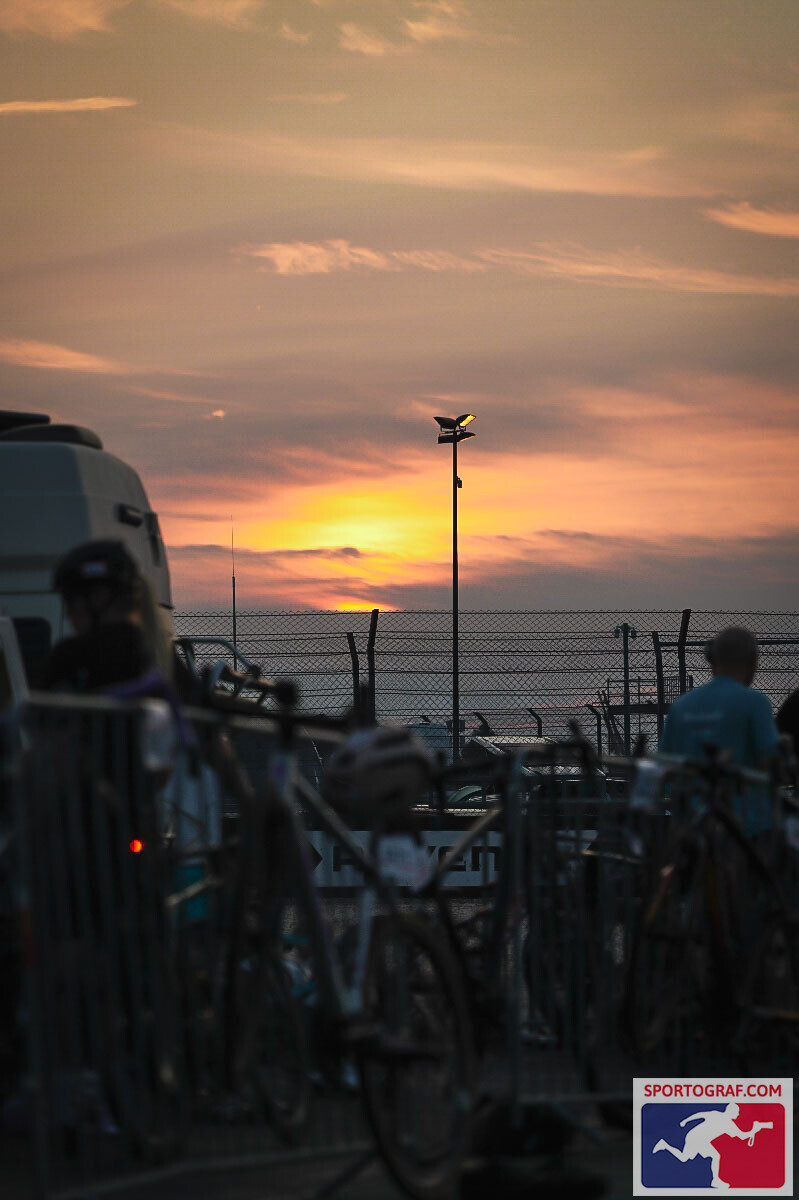
The paddock grows quieter. Lights come on. Riders disappear into the darkness.
At some point you are sitting there. Pitch black. Helmet. Bike. Waiting.
During the day, the changeover zone is busy. At night, most people in the camp are asleep. You are largely on your own.
Our WhatsApp group becomes enormously important. The rider’s ETA. Where is he? When does the next person need to leave?
Then the transponder arrives. You ride out.
The Nordschleife at night. On a road bike.
The adrenaline is different. At night I was roughly three minutes slower per lap.
You could search for sports-science explanations.
Fatigue.
Muscles.
Declining performance.
My explanation is simpler: I had a great deal of respect for it, especially downhill. So I rode more slowly. I can live with that very well.
Hohe Acht, in the middle of the night
You work your way back up to Hohe Acht. It is night.
Fog machine.
Disco lights.
Music.
The DJ is still there. You are riding a road bike through something halfway between a hill climb, a nightclub and complete madness.
At this point, several strands of my story come together.
In 2005, I had experienced my first 24-hour race on this Nordschleife in an organisational role for BMW Motorsport.
I knew nights at the Nürburgring. I knew the light, the noise and the strange sensation of a race continuing while the rest of the world sleeps.
But this perspective was new. This time, I was out there on the circuit myself.
No radio.
No race car.
Just a road bike, two tired legs and me.
And at the top of Hohe Acht: disco lights, fog and that damned DJ.
I will probably remember that moment for the rest of my life.
You are tired.
You are tense.
You are no longer entirely sure what day it is.
And at the same time, there is nowhere else you would rather be.
Sunday morning: daylight returns.
Morning arrives. The camp slowly wakes up.
Coffee. Tired faces. Bicycles.
Our rhythm begins again, except now everyone knows:
Five hours left.
Four.
Three.
One more Nordschleife lap. One more all-out effort.
Then I learn something that experienced Rad am Ring riders probably take for granted. I did not.
The final lap is ridden together.
Lap of Honour
That is what I called it.
The teams gather. The riders from the camp head out onto the Nordschleife together.
Now it is no longer about lap times or positions. We ride together.
Of course, a few riders cannot resist attacking off the front. Cyclists will be cyclists. 😉
But most of us stay together.
At Hohe Acht, we stop. Photo. Exactly where we had climbed again and again over the previous 24 hours.
Then we ride together towards the finish.
Four riders.
One team.
And a large group behind us.
Twenty-four hours at the Nürburgring: done.
And now, a quick pack-up …
You might think the story ends there. It does not.
Now comes the final boss: packing up camp.
You are tired. Really tired. But the tent, little kitchen, bags, bike and food – of which enough remains for the youth hostel already mentioned – all have to go back into the car.
One more shower. Pack everything away. At some point, you really are sitting in the car again.
Then the motorway.
Four hours later, I am back in Stuttgart.
Tired. Exhausted. And very happy.
On the way home, I found myself thinking about how often I had already been to the Nürburgring.
As a child, I stood here and watched. Later, I ran around the Nordschleife. I worked here and experienced 24-hour races from an organisational perspective.
And now, for 24 hours, I had repeatedly been out on the circuit myself.
The weekend sharpened my understanding of 24-hour racing. I already knew much of it: team dynamics, tension, preparation, the night and the constant forward motion of a race that runs for an entire day.
What was new was the perspective from the circuit.
Riding a stint yourself. Returning. Bringing your body back down. Eating. Drinking. Changing. Recovering.
And knowing that in a few hours, you will head out again.
I experienced that rhythm of effort and recovery for the first time that weekend.
Rad am Ring added another perspective to the way I see endurance racing – one you can only gain by riding the course yourself.
In the end, no particular lap time is what I remember most strongly.
It is the moments.
The first lap of the Nordschleife.
Our camp.
The changes.
The night.
Hohe Acht.
The DJ.
The tired faces in the morning.
And the final lap together.
As a child, I stood here and watched.
This time, I rode it myself.
And one thing I know:
It will not be my last time.